Interest Rates: Holding Steady (For Now)
Still in a Wide Sideways Range…
Interest rates are bouncing around in a wide sideways range, avoiding any new highs—for now. Let’s break down what happened this past week and take a look at what’s ahead.
“It’s not so easy to control (pressure) There’s always an easy way to make it better.” White Knuckle Ride by Jamiroquai.
Ukraine and Russia: Tensions Escalate
Things heated up last week between Ukraine and Russia. For the first time in this conflict, Ukraine used Western missiles to strike inside Russia. In response, Russia made the alarming announcement that they’re lowering the threshold for deploying nuclear weapons.
This uncertainty drove a “safe haven” trade into the U.S. dollar and dollar-backed assets like bonds, which helped prices a bit. But the gains were limited because the news also caused oil prices to spike-and higher oil prices are bad news for bonds. Fingers crossed we don’t see further escalation in this region.
Mixed Signals from the Economy
The Philly Fed Manufacturing Index showed more bad news for the manufacturing sector, coming in way below expectations. Manufacturing continues to contract, and the sector is shedding jobs every month. Weak data like this gives the Fed another reason to think about cutting rates again in December.
But the job market tells a different story. Weekly Initial Jobless Claims (a measure of people filing for unemployment for the first time) stayed historically low, showing the labor market is still strong. Since the Fed has made it clear that a cooling labor market is not what they want, they’ve got to be happy seeing layoffs remain minimal.
Housing Market Update
Both Housing Starts and Permits missed expectations last week, showing some weakness. But the National Association of Home Builders (NAHB) is feeling more optimistic about the next six months, thanks to expectations that a new administration will ease regulations and reduce construction costs.
Here’s the NAHB’s plan to tackle the housing affordability crisis by increasing supply:
- Eliminate excessive regulations.
- Promote careers in skilled trades.
- Fix building material supply chains and ease costs.
- Pass tax legislation to boost affordable housing production.
- Overturn inefficient local zoning rules.
- Alleviate permitting roadblocks.
- Adopt cost-effective building codes.
- Reduce local impact fees and upfront taxes on new construction.
- Make it easier for developers to finance projects.
- Update employment policies to allow more flexibility and opportunity.
This blueprint offers some real solutions to increase affordability – now we’ll see if policymakers follow through.
Rates in a Holding Pattern
For the last month, mortgage rates have been moving within a pretty wide range but haven’t hit new highs. The 10-year Treasury Note (which influences mortgage rates) has been bouncing between 4.30% and 4.50%. If it breaks above 4.50%, expect mortgage rates to rise. On the flip side, if it dips below 4.30%, rates should drop.
Bottom Line: Rates are trying to find some stability after spiking in September. With a new administration taking over in a few weeks, we’ll likely see rates and bonds remain choppy until we get more clarity.
Looking Ahead
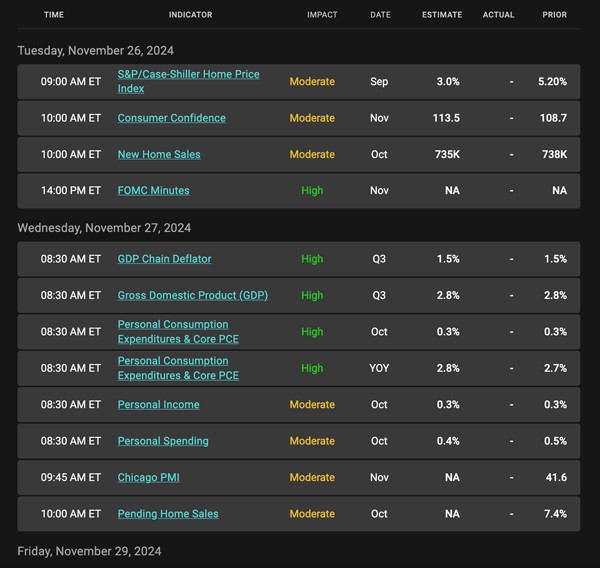
Next week brings some big economic news. We’ll get the Fed’s favorite measure of inflation, the Core PCE Index. This year-over-year number is expected to edge up to 2.8% from 2.7%—still way above the Fed’s 2% target and heading in the wrong direction. There will also be a few important bond auctions that could shake up the market.
And don’t forget, it’s a short trading week with Thanksgiving on Thursday. Lots to digest, in more ways than one. 🦃
Economic Calendar
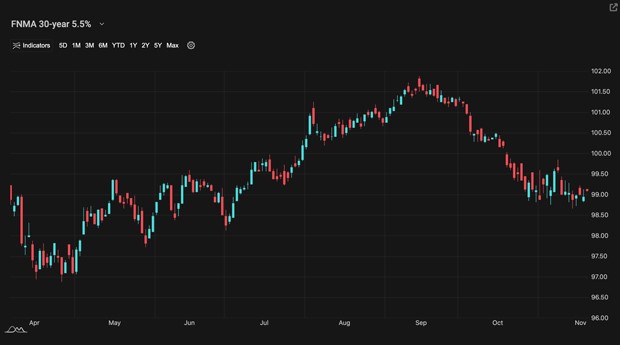
Mortgage bond prices determine home loan rates. The chart below shows a one-year view of the Fannie Mae 30-year 5.5% coupon, where currently closed loans are being packaged. As prices move higher, rates decline, and vice versa.
If you look at the right side of the chart, you can see how prices are moving sideways and resisting the urge to move another leg lower, which would create another spike higher in rates.
Chart: Fannie Mae Mortgage Bond (Friday November 22, 2024)
Economic Calendar for the Week of November 25 – 29