

Volatility is Back: Rates on the Move Again
“Lemme tell ya, you don’t know whatcha do to me…” – Led Zeppelin, We’re Gonna Groove
If you felt like rates were all over the place last week—you’re not wrong. Let’s unpack what happened, and what’s coming around the bend.
Tariff Uncertainty = Good News for Rates
Tariff drama is still front and center, and oddly enough, it’s helping. The uncertainty around trade is pushing investors toward safer assets like bonds, keeping mortgage rates from creeping higher.
You can see it clearly in the 10-year Treasury: it hit 4.60% on April 11th, but today it’s hanging closer to 4.30%. Translation? Rates got a little breathing room.
Housing Market: A Little Spring in Its Step
We got a much-needed shot of good news for housing last week.
New home sales for March blew expectations out of the water—up 7.4% from February, hitting their highest level since September 2024. Builders offered some aggressive incentives, mortgage rates dipped, and boom—buyers showed up, especially in the South.
Even with all the noise around the economy, it’s a good reminder: real demand is still alive and kicking.
Stocks Took a Hit…Then Bounced Right Back
Early in the week, markets got rattled after President Trump took aim at Fed Chair Jerome Powell—going as far as floating the idea of firing him. But by Tuesday, Trump dialed it back, saying he had “no intention” of removing Powell (though he did nudge him for more rate cuts).
Markets liked the softer tone. The S&P 500 jumped 2.5%, and the Nasdaq popped 2.7%.
On the trade front, Treasury Secretary Scott Bessent also threw a little water on the fire, calling the current tariff standoff with China “unsustainable” and hinting at possible progress. Global markets rallied a bit too, though everyone admits formal negotiations haven’t even started yet.
Moral of the story? There’s optimism—but it’s cautious at best.
Treasury Auctions: A Mixed Bag
The government had a few bond auctions last week—and it was a little bit of a “meh” reaction, especially from foreign buyers.
-
The 2-year auction on Tuesday showed weaker foreign demand.
-
The 5-year auction on Wednesday was better, but still not a slam dunk.
The big picture? It’s not a full-on buyer’s strike, but as the U.S. racks up more debt, keeping strong foreign demand for our bonds is going to matter—a lot. Even Fed Chair Powell keeps warning that our debt path is “unsustainable” long-term.
Mortgage Rates: Still in the Same Zone
The 30-year fixed rate mortgage averaged 6.81% as of April 24, just a hair down from 6.83% the week before.
Bottom line: Rates have stayed under pressure—but haven’t broken higher—thanks to calming words from Fed officials, Jamie Dimon, and Scott Bessent back on April 11.
Expect more choppy moves until we get real clarity on tariffs and economic data.
Looking Ahead: Buckle Up for a Big Week
Next week is stacked with important numbers:
-
Core PCE (the Fed’s favorite inflation gauge) comes out, and is expected to drop to 2.5%—the lowest since April 2021.
-
JOLTS (job openings data) and
-
The April Jobs Report on Friday.
And don’t forget: Tariff headlines will still be floating around, ready to move markets when we least expect it.
Final Thought:
Rates want to go lower… but uncertainty keeps tying their shoelaces together. Stay close—we’ll keep navigating it as it unfolds.
Mortgage Market Guide Candlestick Chart
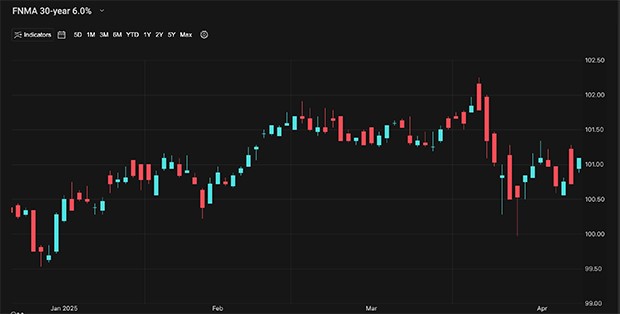
For homebuyers and refinancers, mortgage rates are critical and closely tied to mortgage bond prices. The chart below tracks the Fannie Mae 30-year 6.0% coupon. The rule is simple: rising bond prices mean falling mortgage rates; falling prices mean rising rates. On the right side of the chart, bond prices have rebounded from recent lows, thanks to reassuring statements from Jamie Dimon, Scott Bessent, and the Fed.
Chart: Fannie Mae 30-Year 6.0% Coupon (Friday, April 25, 2025)
Economic Calendar for the Week of Week of April 28 – May 2


