On the heels of Jerome Powell’s Jackson Hole speech, mortgage rates improved once again. Let’s break down what happened and what’s on deck for next week.
“I feel good – like I knew that I would.” – James Brown
“With policy in restrictive territory, the baseline outlook and the shifting balance of risks may warrant adjusting our policy stance.” – Jerome Powell, Jackson Hole, Aug 22, 2025
Powell Pivot
Back on Friday, Aug 22nd, Fed Chair Jerome Powell dropped the line above — and the markets ran with it. His comments signaled that a rate cut is likely coming at the September Fed meeting.
Another key quote that eased inflation fears:
“A reasonable base case is that the effects (from tariffs) will be relatively short lived — a one-time shift in the price level.”
Since Jackson Hole, the odds of a Fed rate cut at the September 17th meeting have jumped to nearly 90%, up from under 70% before his remarks.
Mortgage Spread Narrows to 3-Year Low
Another tailwind for mortgage rates: the spread between the 10-year Treasury note and 30-year mortgage rates has narrowed to its lowest point in three years.
That’s a big deal, because it means mortgage rates aren’t just moving lower on Fed speculation — they’re also getting some technical support.
Mortgage Spread Explained
- The 10-year Treasury note is the benchmark for many interest rates because it’s considered ultra-safe, backed by the U.S. government.
- Mortgage rates (like the 30-year fixed) are usually higher than the 10-year Treasury yield because mortgages carry more risk (e.g., defaults).
- The spread = Mortgage Rate – 10-Year Treasury Yield.
- Example: If the 30-year fixed is 6.5% and the 10-year yield is 4%, the spread = 2.5%.
What Causes the Spread to Narrow?
- Improved Market Confidence – Investors demand less risk premium when they feel good about the economy and mortgage market.
- Lower Perceived Risk in Mortgages – If default/refinance risk is lower, mortgage bonds are more attractive, tightening spreads.
- Fed Actions – Rate cuts or MBS purchases (like during QE) can directly lower mortgage yields.
- Stable Economy – Predictable inflation and growth reduce the risk premium.
- Reduced External Pressures – Less volatility (geopolitical or regulatory) = narrower spreads.
30-Year Mortgage Rate
- The 30-year fixed averaged 6.56% (as of Aug 28, 2025), down from 6.58% the prior week.
10-Year Treasury
- The 10-year Treasury yield continues to bounce between 4.20% – 4.50%, currently hugging the lower end near 4.23%.
Bottom Line
Mortgage rates are sitting near 10-month lows. There’s still resistance (a ceiling in mortgage bond pricing that’s keeping rates from dropping further), so the risk of rates moving higher in the short term is very real.
Looking Ahead
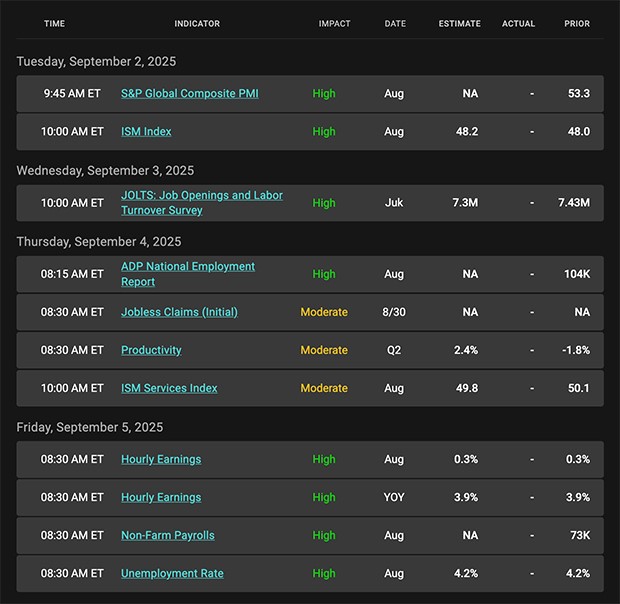
All eyes are on the labor market.
- Last month, the head of the BLS was fired after a brutal Jobs Report with downward revisions.
- This Friday’s report could be even more market-moving than usual.
- ADP’s private payrolls number will hit earlier in the week and may carry extra weight after last month’s volatility.
Stay tuned — the next move in rates may come down to jobs.
⚡That’s your Hutch’s Market Minute for the week. Rates are in a sweet spot, but the market rarely hands out second chances.
Mortgage Market Candle Stick Chart
The chart indicates that mortgage prices are poised to reach an 11-month high, corresponding to the lowest mortgage rates in over 11 months. This positive development aligns with the 10-year Treasury note falling to the bottom of its range at 4.20%.
Chart: Fannie Mae 30-Year 5.5% Coupon (Friday, August 29, 2025)

Economic Calendar for the Week of Week of September 1 – 5