A Look Into the Markets
This past week, interest rates ticked up slightly after hitting their lowest levels in months. Nothing dramatic, but enough to make you ask: what changed? From tariff whiplash to unexpected government spending, markets reacted—and rates moved accordingly. Let’s break it down.
“We live in a land of confusion” – Phil Collins, “Land of Confusion”
That lyric sums up the mood in financial markets this week. After a nice run of falling rates, the momentum stalled. The culprit? A mix of policy uncertainty, global bond market turbulence, and a labor market sending mixed signals.
Tariff Trouble: Markets Hate Uncertainty
Trade policy has been all over the place, and markets are feeling it. Tariffs—essentially taxes on imports—keep bouncing between on, off, and maybe later, leaving investors jittery. One day, tariffs are locked in; the next, they’re paused or adjusted to shield certain industries.
Why does this matter for interest rates? Because tariffs push up prices, fueling inflation. And when inflation rises, the Federal Reserve is less likely to cut rates. Right now, markets are playing a waiting game, hoping for some clarity.
“Whatever It Takes”—Germany’s Spending Bombshell
A German official shook up global bond markets by declaring the country would spend “whatever it takes” on defense and infrastructure. That’s a big deal. Germany has long been known for financial restraint, but this sudden shift sent shockwaves through bond markets.
Here’s why: When governments borrow big, they issue more bonds. More bonds in the market mean lower prices for existing ones, and lower bond prices mean higher yields (aka higher interest rates). The reaction was instant:
-
Germany’s 10-year bond yield shot up from 2.40% to 2.80% in a day—the biggest jump in 40 years.
-
Japan’s bond yields moved higher.
-
The U.S. 10-year Treasury yield spiked from 4.10% to 4.30% in 24 hours.
Bottom line: Markets don’t like unlimited government spending, and bond traders reacted by pushing rates up.
Labor Market: A Yellow Flag, Not a Red One
Closer to home, the ADP employment report came in much weaker than expected—just 77,000 jobs added last month instead of the 150,000 forecasted. Businesses aren’t slashing jobs, but they’re also not hiring aggressively.
-
Unemployment is still low at 4%, so no panic.
-
But if hiring slows further, the Fed could step in with rate cuts to support the economy.
Right now, this isn’t a crisis—just something to keep an eye on.
Fed Rate Predictions: More Cuts on the Horizon?
Wall Street is now betting on three rate cuts in 2025, up from two just a week ago. The first cut is expected in June. But let’s be real—these predictions change fast.
The Fed is stuck in a tough spot:
-
Keep rates high to fight inflation?
-
Cut them if the economy slows too much?
The answer will depend on upcoming data.
The Big Picture
Zoom out, and the trend is clear:
✅ Rates have been coming down for the past six weeks.
🚫 This week, that downward trend paused thanks to Germany’s spending spree, tariff chaos, and labor market uncertainty.
📉 Rates aren’t soaring, but they’re also not falling further—at least not yet.
30-Year Mortgage Rates
The 30-year fixed mortgage averaged 6.63% as of March 6, 2025, down from 6.76% the previous week.
What’s Next?
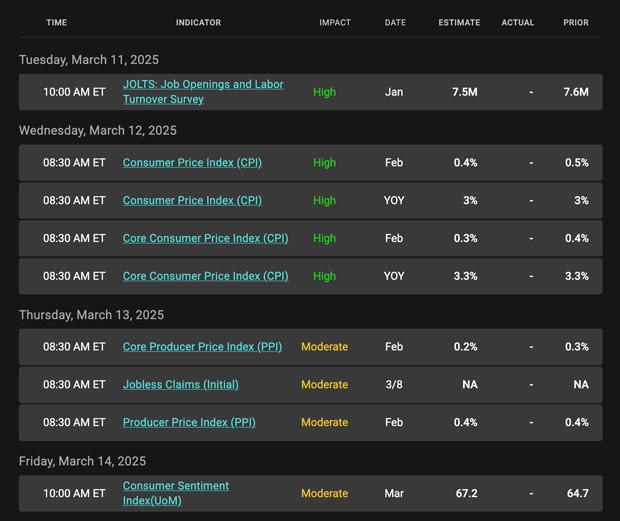
Next week could shake things up again. Here’s what to watch:
🔹 Consumer Price Index (CPI) – The latest inflation report. If inflation comes in lower than expected, expect more talk of Fed rate cuts.
🔹 JOLTS Report – A snapshot of job openings and hiring trends. If hiring slows further, that could push rates down.
🔹 Tariff & Germany Watch – Any breaking news on trade policy or Germany’s budget could jolt markets again.
Stay tuned—we’ll break it all down next time.
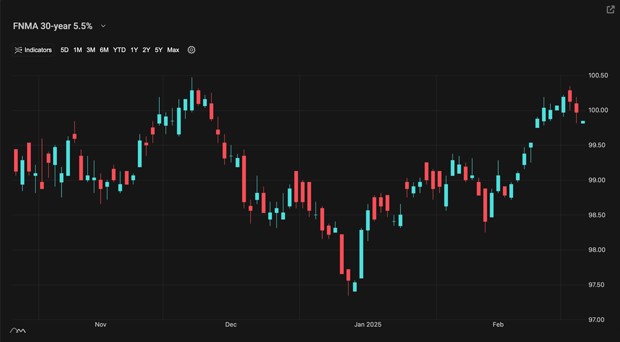
Mortgage Market Guide: Candlestick Chart
For homebuyers and refinancers, mortgage rates are tied to mortgage bond prices. Here’s the deal:
📈 When bond prices rise, mortgage rates fall.
📉 When bond prices drop, mortgage rates go up.
Right now, bond prices have slipped, meaning rates ticked up from their recent lows. But if we get softer inflation data or tariff clarity, we could see rates drift lower again.
Chart: Fannie Mae 30-Year 6.0% Coupon (Friday, March 7, 2025)
Economic Calendar for the Week of Week of March 10 – 14